Hi! Ask me about StudyONsende (features, packages, prices, setup) or about the demo studio in the live demo: its timetable, instructors and packages. For example: "What is included in the web + mobile package?"
Answered by AI and may be wrong; book on the class page. Your question is sent to Anthropic (USA) to generate the answer. So we can get back to you, the chat is shared with our team and stored; you can ask us to delete it. Sharing contact details is optional; do not share health details.
Privacy
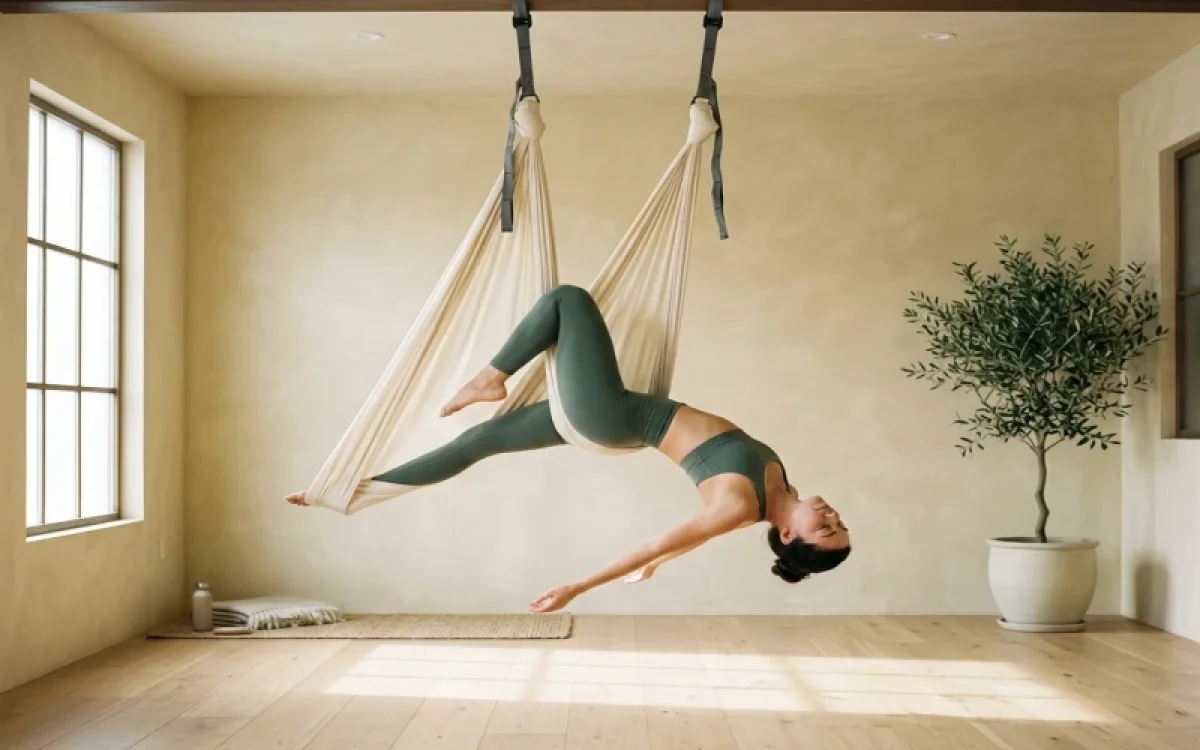
Defy gravity, decompress your spine, and have a fun experience with the help of special silk hammocks.
What is Aerial Yoga?
Aerial yoga is a style of yoga in which classic poses, stretches and inversions are practiced fully or partly off the ground with the help of a silk hammock hung from the ceiling. Inspired by yoga, Pilates and aerial arts, it became popular in the 2000s. The hammock carries your weight to make some poses easier, while others challenge your balance and core more.
The highlight is the supported inversion: you can hang upside down without your head touching the floor or loading your neck. Class also includes gentle swinging, supported stretches and a cocoon-like relaxation inside the hammock at the end. It is beginner-friendly, and aerial yoga for beginners is taught step by step, starting with basic grips and safety.
Who is it for?
People looking for a fun way into yoga: The hammock adds a playful side to practice.
Anyone curious about inversions: The hammock lets you go upside down without loading your head or neck.
People building core and upper-body strength: Gripping and lifting work the arms and abs.
Anyone working on flexibility: The hammock supports the body so some stretches feel easier.
Yogis who want to refresh their routine: Familiar poses take on a new angle.
Which muscles does it work?
Which muscles aerial yoga works becomes clear when you hold on and balance: many groups engage at once.
Rectus abdominis and obliques (abs and side abs): Work constantly as you balance and lift your legs.
Latissimus dorsi (broad back muscle): Engages as you pull yourself up on the fabric.
Forearm flexors and biceps (grip and front of the arm): Grip strength grows as you hold the silk.
Gluteus and hamstrings (glutes and back of the thighs): Work in hammock bridges and leg poses.
Deltoids and rotator cuff (shoulder muscles): Stabilize the shoulder in arm-supported transitions.
Benefits
The benefits of aerial yoga can be felt both physically and mentally:
Core strength: Staying balanced strengthens the abs and back.
Grip and upper-body strength: Holding on builds endurance in the arms and back.
Supported inversions: Experience going upside down without loading the head and neck.
Flexibility: Hammock support may help hips and shoulders open more comfortably.
Body awareness: Balancing in the air sharpens your sense of where your body is.
Enjoyment and confidence: Mastering new moves can boost motivation; research suggests that exercise people enjoy is easier to stick with.
What happens in a class?
A 60-minute aerial yoga class starts with adjusting the hammock height and reviewing safe grips. A warm-up follows, then hammock poses and inversions, and the class closes with relaxation inside the hammock.
Setup and warm-up (10 minutes): Hammock adjustment, joint mobility, light stretches using the hammock for support.
Standing and floor poses (20 minutes): Hammock-supported warrior, balance and hip openers.
Inversions and aerial work (20 minutes): Basic inversions, step by step with the teacher.
Cocoon relaxation (10 minutes): Resting inside the hammock.
Safety tips and things to watch
Inversion contraindications: If you have high blood pressure, glaucoma or high eye pressure, retinal problems, vertigo or balance disorders, heart disease, recent surgery (especially eye, abdominal or spinal), pregnancy or epilepsy, talk to your doctor before joining and skip the inversions.
Tell the teacher: Always share your health conditions and any chance of pregnancy before class.
Come up slowly: Don't stand straight up after an inversion; sit for a few breaths first.
Take dizziness seriously: If you feel nauseous or dizzy, stop the hammock and come down.
Trust the grip: Don't try a new move before the teacher demonstrates it, and always stay connected to the hammock with at least one hand or leg.
Remove jewelry: Rings, watches and earrings can tear the silk or scratch your skin.
How to prepare
Clothing: Fitted clothes that cover your armpits and the backs of your knees to reduce fabric friction.
Lotions: Skip hand and body lotion before class; slippery skin makes gripping harder.
Eating: Because of the inversions, finish eating at least 2 hours before class.
Frequently asked questions
Is aerial yoga suitable for beginners?
Yes. The class is beginner-friendly and teaches basic grips and safety steps as you go. No yoga experience is needed, but it's important to share your health conditions with the teacher.
How much weight can the hammock hold? Could I fall?
Professional hammocks and ceiling rigging are designed to hold loads far greater than body weight. When you follow the teacher's instructions and the hammock is set at the right height, the risk is low.
Can aerial yoga help with weight loss?
Aerial yoga is an enjoyable workout for the core and upper body. It isn't designed for weight loss on its own, but together with regular movement and balanced eating it can be part of a healthy routine.
Are inversions safe for everyone?
No. Inversions aren't recommended with high blood pressure, glaucoma, vertigo, pregnancy or recent surgery. In these cases, talk to your doctor; safe alternatives can replace inversions in class.
Share
Upcoming Sessions
21 November 2026 - 12:00
Instructor: Derin Yıldız
| Cihangir (Prana Salonu)
We use required cookies to keep the site working. With your permission, Google Analytics and YouTube help us measure site usage and display external media. Read our Cookie Policy.