Hi! Ask me about StudyONsende (features, packages, prices, setup) or about the demo studio in the live demo: its timetable, instructors and packages. For example: "What is included in the web + mobile package?"
Answered by AI and may be wrong; book on the class page. Your question is sent to Anthropic (USA) to generate the answer. So we can get back to you, the chat is shared with our team and stored; you can ask us to delete it. Sharing contact details is optional; do not share health details.
Privacy
⏱ 45 min👥 25 capacity🏷 Hybrid (In person + Online)💪 All levels
Channel your life energy, increase lung capacity, and calm your mind with Pranayama techniques.
What are breathing exercises?
Breathing exercises are a practice of consciously guiding the pace, depth, and rhythm of the breath, known in the yoga tradition as pranayama. Techniques such as diaphragmatic breathing, long exhales, alternate nostril breathing (nadi shodhana), and ujjayi are taught simply, seated or lying down.
Pranayama is seen as a bridge between body and mind, and breathwork now draws interest in stress management for its possible effects on the nervous system. The 45-minute class is open to all levels, in studio or online. The focus is on observing the breath without forcing it and building a calm, steady rhythm.
Who is it for?
Anyone looking for a practical stress tool: A few minutes of technique can be used anywhere.
Beginners: Breathing exercises for beginners require no flexibility or fitness.
Those who want to slow the mind before sleep: Long-exhale techniques may help you relax.
Desk workers: A good start for noticing shallow, chest-heavy breathing habits.
People who do yoga, running, or swimming: Breath control and awareness carry over to other training.
Anyone who wants to join from home: The online format needs minimal equipment.
What does it work in the body and mind?
Breathwork is not a muscle workout, but it works the body in concrete ways through the breathing muscles, posture, and nervous system:
Diaphragm (main breathing muscle): You feel the belly and lower ribs expand as it moves.
Intercostal muscles (between the ribs): They open the rib cage sideways and back; lateral rib breathing builds awareness.
Transversus abdominis (deep core): Gently engages during long, controlled exhales.
Postural muscles (erector spinae and neck muscles): An upright, relaxed seat lets the breath flow and reveals neck and shoulder tension.
Autonomic nervous system: Research links slow breathing with long exhales to increased parasympathetic (rest-and-digest) activity and heart rate variability.
Attention: Counting and observing the breath gives the mind an anchor in the present moment.
Benefits
Research on the benefits of breathing exercises is growing; results are promising but vary from person to person:
Stress management: Slow breathing may help you calm down in stressful moments.
Sleep: Breathing before bed can make it easier to fall asleep.
Focus: Short breathing breaks may support concentration.
Breath awareness: You learn to notice shallow, fast, or held breathing habits.
Posture: A relaxed, upright seat can create a freer feeling in the chest and shoulders.
Emotional regulation: Using the breath as an anchor may help you meet strong emotions more calmly.
Portability: No equipment needed; practice at work, on the go, or at home.
What happens in a class?
The 45-minute class starts by finding a comfortable seat and observing your natural breath. In the main part, several techniques are practiced in short rounds with rest in between, and class closes with quiet sitting or lying relaxation. Online, the instructor guides with clear verbal cues.
Preparation (8 min): Neck and shoulder release, setting up your seat, observing natural breath.
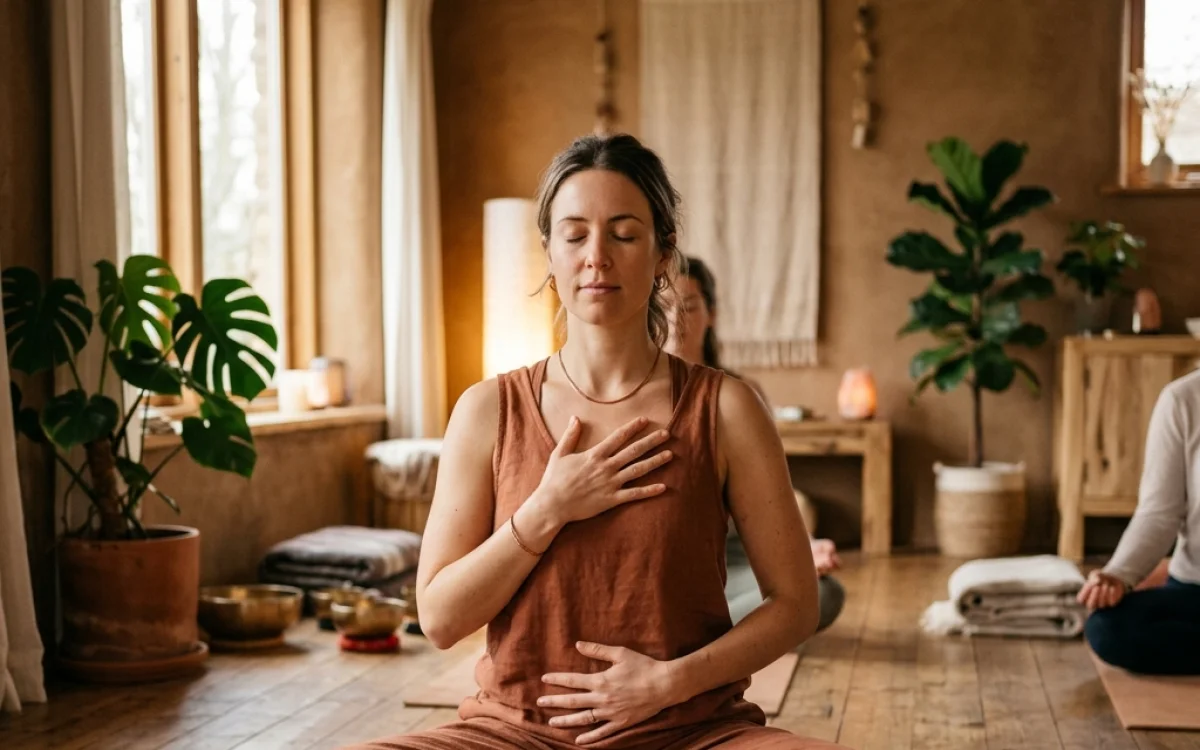
Diaphragm and rib breathing (10 min): Hands on the belly and ribs to feel the breath move.
Rhythmic techniques (17 min): Long exhales, box breathing, and alternate nostril breathing.
Closing (10 min): Quiet sitting or lying relaxation.
Safety tips and things to watch
Check with your doctor first: If you are pregnant or have high blood pressure, a heart condition, epilepsy, panic disorder, or a serious respiratory condition, avoid breath retention (kumbhaka) and fast breathing (such as kapalabhati or bhastrika), and talk to your doctor before class.
Ask for alternatives: In these cases, the instructor offers only slow breathing without retention.
Never force it: Breathing should stay easy and quiet; air hunger is a sign to pause, not progress.
Watch for dizziness: If you feel tingling or lightheaded, return to natural breathing and rest.
Emotions are normal: You can open your eyes and stop anytime.
Support your seat: Use a chair, block, or cushion as needed.
Not while driving: Never practice techniques that can cause deep relaxation or dizziness in water or behind the wheel.
How to prepare
Wear clothes that do not squeeze your belly or waist; keep a light layer or blanket nearby.
If joining online, set up a quiet space, a mat or cushion, and a stable connection.
Avoid heavy meals 1–2 hours before; breathing on a full stomach is harder.
Clear your nose beforehand and keep water nearby.
Frequently asked questions
Do breathing exercises reduce stress?
Research links slow breathing practices with lower perceived stress and a calmer physiological state. Effects vary and may become clearer with regular practice.
Are pranayama and breathing exercises the same thing?
Pranayama is the general name for breathing techniques from the yoga tradition. Class includes both traditional pranayama and simple, widely used modern breathing exercises.
Is an online class as effective as one in the studio?
Breathwork needs no equipment, so it suits online classes well. In the studio, the instructor can also adjust your seat in person.
How often should I practice?
One or two classes a week plus 5–10 minutes a day in between is a good start. Short, regular practice is usually more sustainable than long, occasional sessions.
We use required cookies to keep the site working. With your permission, Google Analytics and YouTube help us measure site usage and display external media. Read our Cookie Policy.