Hi! Ask me about StudyONsende (features, packages, prices, setup) or about the demo studio in the live demo: its timetable, instructors and packages. For example: "What is included in the web + mobile package?"
Answered by AI and may be wrong; book on the class page. Your question is sent to Anthropic (USA) to generate the answer. So we can get back to you, the chat is shared with our team and stored; you can ask us to delete it. Sharing contact details is optional; do not share health details.
Privacy
Allow the body to heal itself by staying in poses for a long time using supportive yoga props.
What is Restorative Yoga?
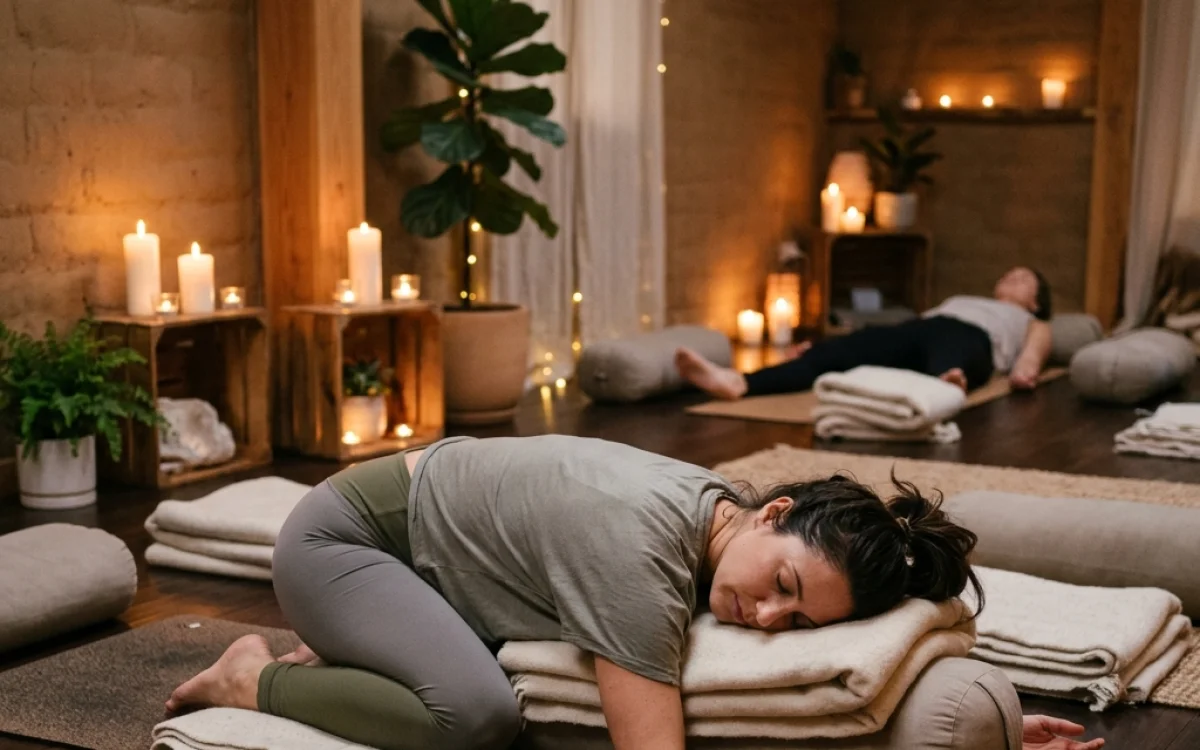
Restorative yoga is a style of yoga focused on deep relaxation, in which the body is fully supported by bolsters, blocks and blankets and a few poses are held for a long time. It grows out of the Iyengar approach, which adapts yoga to each person's health needs. A class usually includes 5 to 7 poses, each held for 5 to 10 minutes.
The emphasis is on letting go, not on effort. Because the props carry your weight, the muscles can soften instead of working. Dim light, a quiet room and breath-focused cues help the nervous system shift into its "rest and digest" mode. Restorative yoga suits all levels, and restorative yoga for beginners is one of the most accessible ways to start, since it needs no flexibility or strength.
Who is it for?
People under heavy stress: Long, supported rest gives the mind space to slow down.
People with sleep troubles: An evening class can help you unwind before bed.
Athletes who train hard: A gentle option for an active recovery day.
Beginners: No difficult poses, balance or flexibility are expected.
People dealing with fatigue or limited mobility: Props adapt every pose to your body.
Which muscles does it work?
Which muscles does restorative yoga work? The goal is not to work them but to release them on purpose. Still, certain areas open gently:
Diaphragm (main breathing muscle): Has room to move more fully and slowly in supported chest openers.
Iliopsoas (hip flexors): Lengthens passively in poses like supported bridge.
Pectoralis major and minor (chest muscles): Rounded shoulders open as you lie back over a bolster.
Hamstrings (back of the thighs): Stretch without strain in legs up the wall.
Erector spinae and quadratus lumborum (back and lower back muscles): Let go of tension in supported forward folds and twists.
Autonomic nervous system: Not a muscle, but the real focus; slow breathing and support encourage the relaxation response.
Benefits
The benefits of restorative yoga show up mostly as rest and recovery:
Deep relaxation: Research links slow, supported practices with lower perceived stress.
Sleep support: Regular practice may make it easier for some people to fall asleep.
Slower breathing: As the chest and belly open, the breath naturally deepens.
Recovery: May help the body rest after intense training.
Body awareness: Long holds help you notice where tension builds up.
Ease of movement: Passive lengthening can ease everyday stiffness.
What happens in a class?
A 75-minute restorative yoga class begins with brief breath awareness and gentle movement. The teacher helps you set up props for each pose; your only job is to settle in and follow your breath. The class closes with a long final rest.
Opening (10 minutes): Seated or reclined breath awareness and gentle spinal movement.
Supported poses (50 minutes): Around 5 to 7 poses such as supported child's pose, supported bridge, legs up the wall, side-lying rest and a supported twist.
Final rest (10-15 minutes): A fully supported savasana under a blanket.
Safety tips and things to watch
Comfort comes first: If you feel a pull, ache or pressure, rearrange the props.
Stay warm: Body temperature drops when you are still for a long time, so use a blanket and socks.
Watch for numbness: If an arm or leg starts tingling, slowly change position.
Get up slowly: After long rests, roll to your side before sitting up; standing too fast can cause dizziness.
During pregnancy: From the second trimester on, avoid lying flat on your back for long; choose side-lying and inclined setups, and check with your doctor or midwife first.
Health conditions: If you've had recent surgery, or have acute back or neck pain, glaucoma or uncontrolled blood pressure, talk to your doctor first and let the teacher know.
How to prepare
Clothing: Soft, loose, warm layers; bring a light cardigan and socks.
What to bring: Water and an eye pillow if you like; bolsters, blocks and blankets are provided.
Eating: Have something light 1 to 2 hours before; lying down on a full stomach can be uncomfortable.
Frequently asked questions
Is restorative yoga the same as yin yoga?
No. Both hold poses for a long time, but yin yoga aims for a mild stretch in the connective tissue. In restorative yoga the props remove almost all stretch, so the goal is pure relaxation.
Is it okay if I fall asleep in class?
Absolutely. Deep relaxation sometimes turns into sleep, which may simply mean your body needs rest. The teacher will gently guide you between poses.
Can restorative yoga help with weight loss?
Restorative yoga doesn't burn many calories. Because it may help you manage stress and support healthy sleep, though, it can be a balancing part of a healthy lifestyle.
How often should I practice?
One or two classes a week strikes a good balance, especially alongside a more dynamic workout routine. Coming more often during stressful periods is perfectly safe.
We use required cookies to keep the site working. With your permission, Google Analytics and YouTube help us measure site usage and display external media. Read our Cookie Policy.