Hi! Ask me about StudyONsende (features, packages, prices, setup) or about the demo studio in the live demo: its timetable, instructors and packages. For example: "What is included in the web + mobile package?"
Answered by AI and may be wrong; book on the class page. Your question is sent to Anthropic (USA) to generate the answer. So we can get back to you, the chat is shared with our team and stored; you can ask us to delete it. Sharing contact details is optional; do not share health details.
Privacy
⏱ 60 min👥 15 capacity🏷 Hybrid (In person + Online)💪 All levels
A slow practice focusing on internal sensations to release chronic muscle tension and soothe the nervous system.
What is Somatic Movement?
Somatic movement is a movement practice that uses slow, mindful movement to focus on how the body feels from the inside, with the aim of noticing and releasing habitual muscle tension. It draws on approaches such as the Feldenkrais Method, Hanna Somatics, and Body-Mind Centering; what matters is how you sense movement, not how it looks.
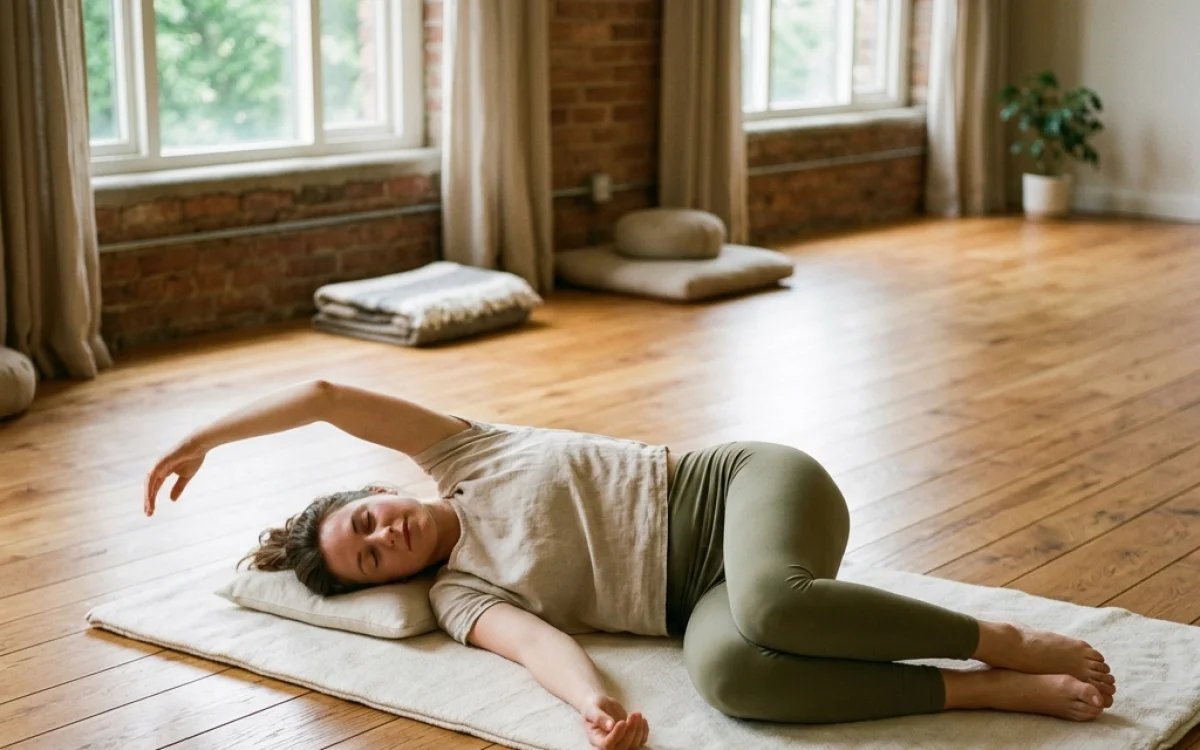
Class uses small, soft, repeated movements, mostly lying on the floor. A technique called pandiculation, a conscious contract-and-slowly-release, helps you sense the resting length of your muscles again. The 60-minute class is open to all levels, in studio or online.
Who is it for?
People with chronic neck, back, or shoulder tension: Noticing habitual tightness may help you release it.
Beginners: Somatic movement for beginners requires no flexibility, strength, or experience.
Desk workers: It teaches you to observe posture habits from the inside.
Athletes and dancers: On recovery days, it can support movement quality and body awareness.
Anyone who feels stress building up in the body: The slow pace creates a calming setting for the nervous system.
Older adults: A low-intensity, joint-friendly option.
Which muscles and systems does it work?
Which muscles does somatic movement work? The answer differs from strength training: the goal is not to tire muscles but to refresh communication between brain and muscle.
Erector spinae (back muscles): Contracted and released in arching and rounding movements; built-up back tension becomes noticeable.
Rectus abdominis and obliques (front and side abs): Gently worked in curling and side-lengthening; habits that collapse the chest become visible.
Psoas and hip flexors (front of the hips): Softened with slow leg movements; you feel the effect of long sitting.
Trapezius and levator scapulae (shoulder and neck muscles): Shoulder lift-and-release builds awareness of tension.
Deep stabilizers (small spinal muscles such as multifidus): Engaged in small, controlled movements.
Nervous system: Slow, attentive movement trains proprioception (sensing where your body is in space) and interoception.
Benefits
Research on the benefits of somatic movement is still limited; these are possible effects commonly reported by practitioners and seen in studies of related approaches:
Feeling less tense: Conscious contract-and-release may help you notice and reduce chronic tension.
Ease of movement: Learning to move with less effort can make daily tasks easier.
Posture awareness: You notice sitting and standing habits from the inside.
Balance and coordination: The focus on proprioception may support balance.
Stress management: Slow pace and breathing can support a calmer state of mind.
Relationship with your body: It builds a habit of listening to your body without judgment.
Support for other practices: It may improve movement quality in yoga, Pilates, and sports.
What happens in a class?
The 60-minute class begins lying on the floor with a body scan and breath awareness. In the main part, short movement sequences are repeated very slowly, with rest after each to notice what changed. Online, the instructor describes movements with detailed verbal cues.
Body scan (10 min): Lying on your back, noticing where the body meets the floor.
Pandiculation (15 min): Conscious contract-and-release for the back, front, and sides of the body.
Exploration sequences (25 min): Pelvic clocks, spinal waves, shoulder and hip movements.
Integration (10 min): Slowly standing, walking to feel the difference, and resting.
Safety tips and things to watch
Less is more: Keep movements small and slow; forcing works against the release you want.
Stay out of pain: Make a painful movement smaller or simply imagine it.
Do not hold your breath: Let the breath flow naturally throughout.
Check with your doctor first: After recent surgery, or with an acute injury, disc herniation, osteoporosis, or a neurological condition, talk to your doctor or physical therapist before starting.
Adapt during pregnancy: Let the instructor know; back-lying and belly-lying moves will be modified.
Notice emotions: Body awareness can sometimes bring feelings up; you can always pause.
Not a replacement for treatment: Somatic movement does not replace medical care for diagnosed pain or illness.
How to prepare
Wear clothes that let you move freely on the floor; bring socks or a light layer.
If joining online, set up floor space, a mat, a small pillow, and a blanket.
Avoid heavy meals 1–2 hours before class.
Tell the instructor about any injuries or health conditions before class.
Frequently asked questions
What is the difference between somatic movement and yoga?
Yoga is built on specific poses and flows, while somatic movement focuses on how movement feels from the inside rather than how a pose looks. The two complement each other well.
Can somatic movement help with back pain?
Many people report relief from back tension, but research is still limited. If you have a diagnosed back problem, talk to your doctor or physical therapist first.
I am not flexible at all. Can I join?
Yes. Somatic movement needs no flexibility; movements are small and adapted to every body.
How often should I practice?
One or two classes a week is a good start. Repeating short sequences at home for a few minutes a day helps bring that awareness into daily life.
We use required cookies to keep the site working. With your permission, Google Analytics and YouTube help us measure site usage and display external media. Read our Cookie Policy.