Hi! Ask me about StudyONsende (features, packages, prices, setup) or about the demo studio in the live demo: its timetable, instructors and packages. For example: "What is included in the web + mobile package?"
Answered by AI and may be wrong; book on the class page. Your question is sent to Anthropic (USA) to generate the answer. So we can get back to you, the chat is shared with our team and stored; you can ask us to delete it. Sharing contact details is optional; do not share health details.
Privacy
⏱ 60 min👥 20 capacity🏷 Hybrid (In person + Online)💪 All levels
A balanced combination of active, dynamic flows (Yang) and passive, deeply relaxing poses (Yin).
What is Yin Yang Yoga?
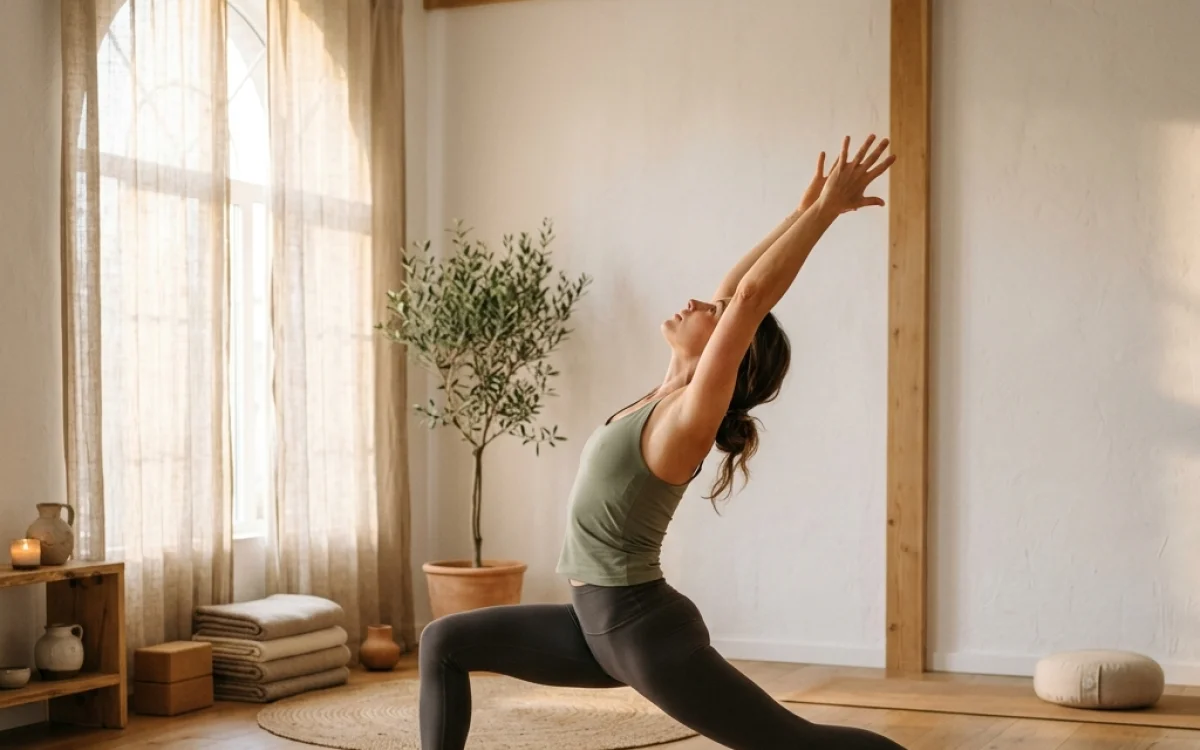
Yin Yang yoga is a balanced style of yoga that combines an active, flowing "yang" section with a passive "yin" section of long, floor-based holds in the same class. Its name comes from two complementary opposites in Chinese philosophy: yang stands for movement, heat and strength, while yin stands for stillness, patience and letting go.
In the yang section, vinyasa-style flows and strengthening poses warm up and work the muscles. In the yin section, poses are held for 3 to 5 minutes to give a gentle stretch to the connective tissue around the hips, lower back and hamstrings. It suits all levels, and Yin Yang yoga for beginners is an easy way to experience both movement and rest in one class. You can join in the studio or online.
Who is it for?
People who want both movement and rest: One class balances energy and calm.
Anyone working on flexibility: Long yin holds may help open the hips and hamstrings.
Desk workers: Tight hips and lower back are approached both actively and passively.
Beginners: An easier option is offered for every pose.
People who prefer to practice at home: The online option makes regular practice easier.
Which muscles does it work?
Which muscles Yin Yang yoga works differs between the two halves: the yang part strengthens muscles, while the yin part gently stretches connective tissue.
Quadriceps and gluteus (front thighs and glutes): Build strength in warrior and chair poses.
Rectus abdominis and obliques (abs and side abs): Stabilize the torso during flows and plank variations.
Deltoids and triceps (shoulders and back of the arms): Work in downward dog and push-up transitions.
Hip rotators and adductors (deep hip and inner thigh muscles): Open slowly in yin poses such as butterfly and pigeon.
Hamstrings and erector spinae (back of the thighs and back muscles): Lengthen without strain in yin forward folds.
Benefits
The benefits of Yin Yang yoga come from how the two approaches complement each other:
A balanced practice: Strength and flexibility are addressed in the same class.
Range of motion: Long yin holds may support hip and spinal mobility.
Muscular endurance: Yang flows strengthen the legs, core and shoulders.
Stress management: Research links slow-paced yoga and breathwork with lower perceived stress.
Patience and focus: Quiet yin holds teach you to turn your attention inward.
Rest and relaxation: The calm ending may help you unwind in the evening.
What happens in a class?
A 60-minute Yin Yang yoga class starts with brief breathwork and a warm-up. The yang flow comes next, and the class winds down with yin poses and rest. Some classes reverse the order.
Opening and warm-up (10 minutes): Breath awareness, joint mobility, cat-cow.
Yang section (20-25 minutes): Sun salutations, warrior poses, balance and core work.
Yin section (20 minutes): Passive holds of 3 to 5 minutes, such as butterfly, half pigeon and caterpillar.
Closing (5 minutes): Savasana and a short breath awareness.
Safety tips and things to watch
In yin, a mild stretch is enough: Keep the intensity around 5 or 6 out of 10; sharp or stabbing pain means stop.
Come out slowly: After long holds, joints can feel vulnerable for a few seconds.
Alignment in yang: Keep knees over ankles and pointing the same way as your toes.
Keep the breath flowing: If you're holding your breath, the pace or intensity is too much.
Practicing online: Use a non-slip mat and make sure you have enough clear space around you.
Health conditions: If you are pregnant, have had recent surgery, or have hypermobile joints, a herniated disc or a serious joint condition, talk to your doctor first and let the teacher know.
How to prepare
Clothing: Stretchy, comfortable clothes; a light layer helps during the yin section.
What to bring: Water and a towel; at home, a book can replace a block and a folded blanket can replace a bolster.
Eating: Avoid a heavy meal 2 hours before class; a light snack up to an hour before is fine.
Frequently asked questions
What's the difference between Yin Yang yoga and yin yoga?
Yin yoga consists only of long, passive holds. Yin Yang yoga adds an active flow section, so in the same class you strengthen your muscles and gently stretch your connective tissue.
I'm not flexible. Can I join?
Of course. Flexibility isn't a requirement for this class; it's something that can develop over time. Props like blocks and blankets let every pose adapt to your body.
Can Yin Yang yoga help with weight loss?
The yang section raises your heart rate a little, but this class isn't designed for weight loss on its own. Combined with regular movement, balanced eating and good sleep, it can be part of a healthy routine.
Is an online class as effective as one in the studio?
Online classes make regular practice easy. Since the teacher can't see you up close, beginners may learn alignment more easily by taking their first classes in the studio.
We use required cookies to keep the site working. With your permission, Google Analytics and YouTube help us measure site usage and display external media. Read our Cookie Policy.