Hi! Ask me about StudyONsende (features, packages, prices, setup) or about the demo studio in the live demo: its timetable, instructors and packages. For example: "What is included in the web + mobile package?"
Answered by AI and may be wrong; book on the class page. Your question is sent to Anthropic (USA) to generate the answer. So we can get back to you, the chat is shared with our team and stored; you can ask us to delete it. Sharing contact details is optional; do not share health details.
Privacy
⏱ 75 min👥 20 capacity🏷 Hybrid (In person + Online)💪 All levels
Achieve deep mental and physical relaxation by stretching deep connective tissues in slow-paced poses.
What is Yin Yoga?
Yin yoga is a slow, introspective style of yoga in which passive floor poses are held, usually for 3–5 minutes each. It developed in the late 1970s, drawing on Taoist thought and martial arts traditions, and later took on its current name. In Taoist philosophy, yin represents what is calm, still, and receptive, and the class reflects those qualities.
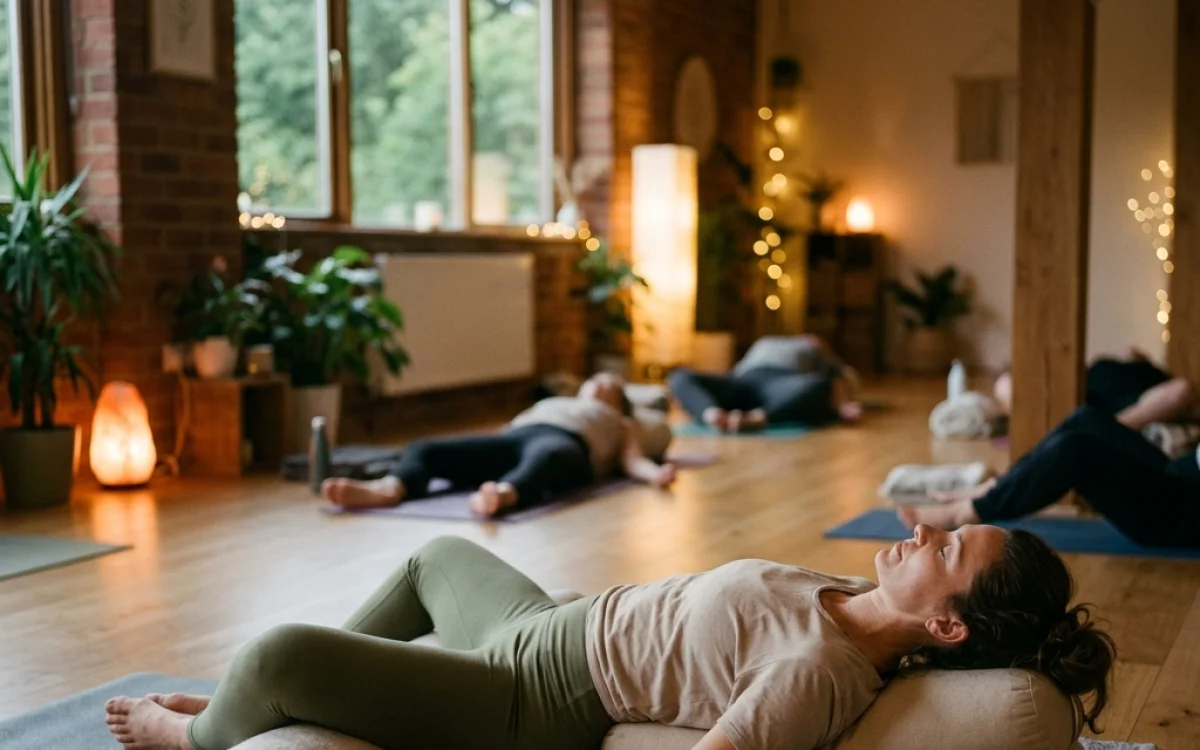
Rather than actively contracting muscles, you let the body yield to gravity. Long holds gently load both muscles and connective tissue such as fascia and ligaments. Silence, breath awareness, and observing sensations are at the heart of the practice. You can join in the studio or online.
Who is it for?
All levels: The poses are simple; no flexibility or experience is required.
Beginners: Yin yoga for beginners is a gentle way to get to know your body and ease into yoga.
Active people: Balances intense training like running, fitness, or Vinyasa.
People with busy, stressful lives: A dedicated time to slow down and quiet the mind.
Anyone with tight hips or lower back: Helps ease tension from long hours of sitting.
People practicing from home: The online option works with minimal equipment.
Which muscles does it work?
Which muscles does Yin yoga work? The answer is a little different: the goal is not to strengthen muscles but to gently load muscle and connective tissue through long stretches.
Iliopsoas (hip flexors): Stretched for long periods in dragon and lizard-like poses.
Hamstrings (back of the thighs): Lengthen slowly in caterpillar, a seated forward fold.
Piriformis and gluteals (deep hip muscles): Have time to release in pigeon-style hip openers.
Adductors (inner thighs): Stretched in butterfly and dragon variations.
Erector spinae and quadratus lumborum (back and lower back): Lengthen in forward folds and side bends.
Thoracolumbar fascia (connective tissue of the back): Receives sustained, gentle tension during long holds.
Diaphragm (breathing muscle): Works in a calm rhythm with slow, deep breathing.
Benefits
The benefits of Yin yoga usually come with patience and regular practice:
Range of motion: May support flexibility, especially in the hips, lower back, and hamstrings.
Relaxation: Long, quiet holds can support activation of the parasympathetic nervous system (rest and digest mode).
Stress management: Research associates slow-paced yoga and breathwork with lower perceived stress.
Mindfulness: Observing sensations while staying in a pose is a practice in attention and patience.
Recovery: A balancing practice after intense workouts.
Sleep: An evening Yin practice may help some people fall asleep more easily.
Accessibility: Calm poses close to the floor suit people of different ages and fitness levels.
What happens in a class?
A 75-minute Yin class begins with a short settling-in period, continues with a few long-held poses, and ends with extended rest. Props help you find a comfortable position.
Opening (10 minutes): Seated or lying breath awareness and a body scan.
Main section (50 minutes): 7–10 floor poses held 3–5 minutes each, with short neutral rests in between.
Closing (10–15 minutes): A gentle twist, then a long savasana.
Joining online: At home, pillows, blankets, and thick books can stand in for bolsters and blocks.
Safety tips and things to watch
The 60–70% rule: Don't go to your maximum stretch; choose an intensity you can comfortably hold for a long time.
Sensation, not pain: A mild stretch is normal; sharp pain, stabbing sensations, or numbness mean come out of the pose.
Exit slowly: After long holds, come out gently and rest for a few breaths.
Use props: Bolsters, blocks, and blankets make poses sustainable.
Hypermobility: If your joints are very flexible, practice lighter versions and don't push to the end of your range.
Check with your doctor first: If you have a herniated disc, osteoporosis, a joint injury, recent surgery, or are pregnant, talk to your doctor before starting and let your instructor know.
How to prepare
Clothing: Comfortable layers and socks; your body temperature can drop during long holds.
Equipment: Props are available in the studio; for online classes, keep a pillow and blanket nearby.
Food: Avoid heavy meals for 1.5–2 hours before class.
Space: Online, choose a quiet, softly lit corner and silence notifications.
Frequently asked questions
I'm not flexible. Is Yin yoga right for me?
Yes. Yin yoga doesn't require flexibility; it is designed to support it gently. With props, every pose can be adjusted to your body.
Is Yin yoga the same as restorative yoga?
No. Both are slow and close to the floor, but Yin aims for a mild stretch in connective tissue. Restorative yoga fully supports the body with props, keeping stretch to a minimum.
How often should I do Yin yoga?
One or two Yin classes a week balance dynamic training well. If Yin is your only practice, two to three classes a week also works.
Is an online Yin class as effective as one in the studio?
Because Yin is slow and floor-based, it works very well online. Placing your camera to show your side profile helps the instructor follow your alignment.
We use required cookies to keep the site working. With your permission, Google Analytics and YouTube help us measure site usage and display external media. Read our Cookie Policy.